.svg)
What Are the Mailroom Management Models for the Multi-Building Modern Campus?


The traditional one-room-fits-all mailroom management model is failing on multi-building modern campuses. Whether the site is a prestigious university or a multinational corporate headquarters, parcel volume has reached a tipping point that has outpaced physical infrastructure. Increased e-commerce volumes and the expectation for instant access have forced a shift toward decentralized logistics.
Industry data confirms that the stakes for internal distribution have never been higher. According to McKinsey, while speed was once the primary driver of satisfaction, 90% of consumers are now willing to wait longer for deliveries if the process is reliable and transparent. Furthermore, Deloitte research highlights that real-time tracking is no longer a luxury. It is a fundamental requirement for reducing "Where Is My Order" (WISMO) inquiries, which can account for up to 50% of all inbound support calls.
For the present-day campus, this means the last mile of delivery is about the reliability of a parcel's arrival in a recipient’s hands within the campus sprawl. To meet these expectations, forward-thinking facilities are moving toward the following four decentralized models.

1. The Distributed Micro-Hub Model
This involves receiving all parcels at a central loading dock and immediately shuttling them to strategically placed satellite rooms. These micro-hubs are located in high-density areas, such as a specific dorm quad or a departmental wing.
- The Workflow: Bulk arrival at a central dock to zone sorting to final-mile shuttle to satellites for pickup.
- Best For: Campuses with distinct high-traffic residential or office clusters.
- Pros: Reduces recipient travel distance and keeps high-volume sorting away from public areas.
- Cons: Requires additional staffing for each satellite location to manage pickup windows.
2. The 24/7 Smart Locker Network
Instead of building physical rooms with staff, many campuses are opting for a locker-first approach. These modular units are placed in outdoor common areas, parking structures, or building lobbies to provide contactless, round-the-clock access.
- The Workflow: Staff scan parcels into lockers to automated QR code notification to 24/7 recipient retrieval.
- Best For: Students and hybrid employees who need access outside of standard business hours.
- Pros: 100% self-service, high security, and automated proof of delivery.
- Cons: Significant upfront hardware cost and requires weather-proofing for outdoor units.
3. The Mobile Mailroom (Pop-Up Logistics)

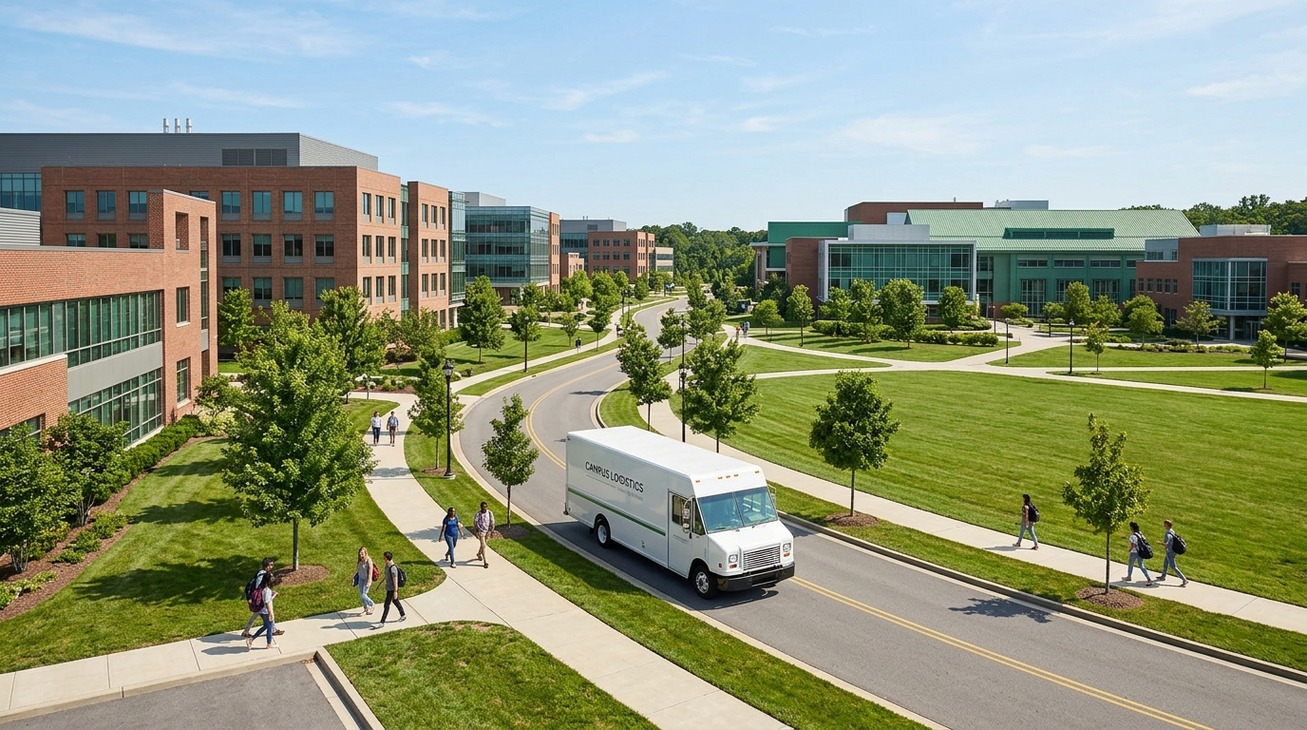
Permanent infrastructure isn't always efficient for seasonal spikes, such as move-in week or corporate holiday gifting. This model uses electric cargo vans or trailers as roaming distribution points.
- The Workflow: The van parks in a designated quad for a scheduled window. Recipients are notified when the pickup window is active at their specific location.
- Best For: Managing seasonal surges or servicing remote areas of a campus that do not justify a permanent building.
- Pros: Highly scalable with zero permanent real estate footprint.
- Cons: Highly dependent on weather and requires precise scheduling.
4. The Internal Courier (White-Glove) Model

In premium corporate environments or specialized research labs, the mailroom acts as a private courier service. This involves bringing the parcel directly to the desk, office, or lab bench rather than the recipient coming to a hub.
- The Workflow: Staff use mobile apps to map efficient delivery routes through buildings and capture digital signatures or photos upon arrival.
- Best For: Executive offices, legal firms, or high-security research labs.
- Pros: Highest level of service ensures that parcels never sit unattended in a lobby.
- Cons: Highest labor cost and requires 100% digital tracking to avoid lost items during transit.
Comparative Analysis: Choosing Your Strategy
When selecting the ideal model for a multi-building campus, facility managers must balance labor availability against technological investment and scalability.
The distributed micro-hub and internal courier models are the most labor-intensive. They require significant staffing to manage satellite rooms or desk-side deliveries. While the micro-hub offers a traditional and familiar experience, the internal courier provides a premium white-glove service. This is essential for high-security environments such as law firms or research labs. However, these models are often the most difficult to scale quickly during peak seasons.
In contrast, the 24/7 smart locker network and mobile mailroom models prioritize high scalability and lower long-term labor costs. Smart lockers offer the most convenient, tech-forward experience for recipients who need 24/7 access. However, they involve a higher upfront capital expenditure for hardware. The mobile mailroom offers a unique middle ground. It is highly adaptable to seasonal surges without requiring a permanent real estate footprint.
Ultimately, the most successful campuses avoid a single-track approach. They instead implement a hybrid strategy that leverages the strengths of each model to meet different departmental needs.
The Hybrid Path Forward for Campus Mailrooms
The future of campus logistics is a hybrid model. A university might use micro-hubs for general mail, Smart lockers for 24/7 library pickups, and mobile units during the first week of the semester.
Regardless of the physical model you choose, a unified parcel management control center is required to prevent data silos and lost parcels. Optimize your campus mailroom flow and ensure every parcel reaches its destination with Parcel Tracker.



.svg)