.svg)
Designing an Efficient Internal Delivery Route

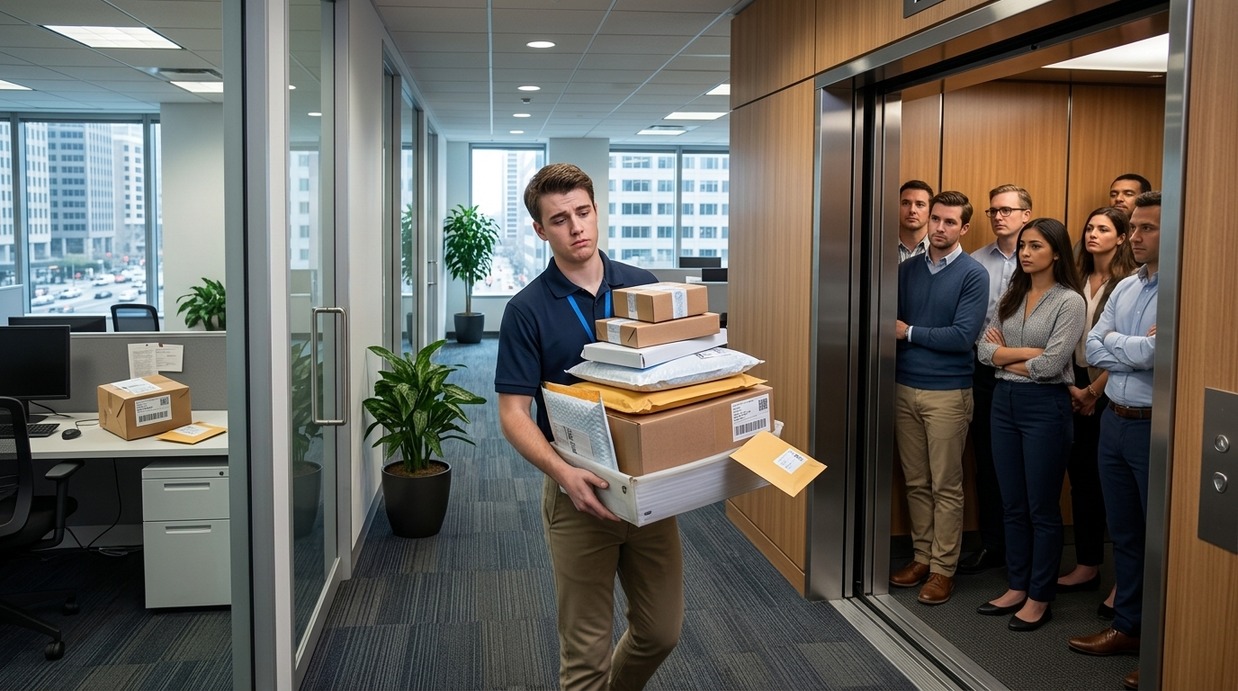
Mailroom staff in large corporate offices or multi-story buildings spend significant portions of their day walking between floors to drop off individual packages at specific desks. This fragmented approach leads to inefficient back-and-forth routes across floors, creating delays at the mailroom and leaving incoming inventory unrecorded. Teams can restructure internal logistics to balance employee convenience with everyday labor limits.
The Problem With Unstructured Internal Deliveries
When staff leave mailroom to deliver single items immediately upon arrival, the entire receiving workflow breaks down. Staff members clock miles of foot traffic each day, moving up and down elevators for individual drop-offs. Meanwhile, inbound parcels stack up at the mailroom, creating a secondary bottleneck that slows down processing for subsequent courier arrivals.
Unstructured drop-offs create blind spots in custody records. When packages are left on unattended desks, recipients often spend time searching for missing items or submitting internal IT and facility support tickets. Digitizing these workflows allows organizations to maintain complete visibility over inbound items. Using technology-driven software strategies can yield up to a 60% reduction in mailroom costs through streamlined processing.
Effective mailroom management establishes structure at the front door. Converting chaotic intake routines into scheduled distribution paths protects staff availability and ensures every item is logged before it leaves the mailroom.
Comparing Internal Distribution Strategies
Selecting the right internal delivery model requires mailroom managers to balance staff labor constraints with building layout and tenant expectations. Comparing these core strategies highlights how physical distribution models impact efficiency and parcel security across different facility sizes.
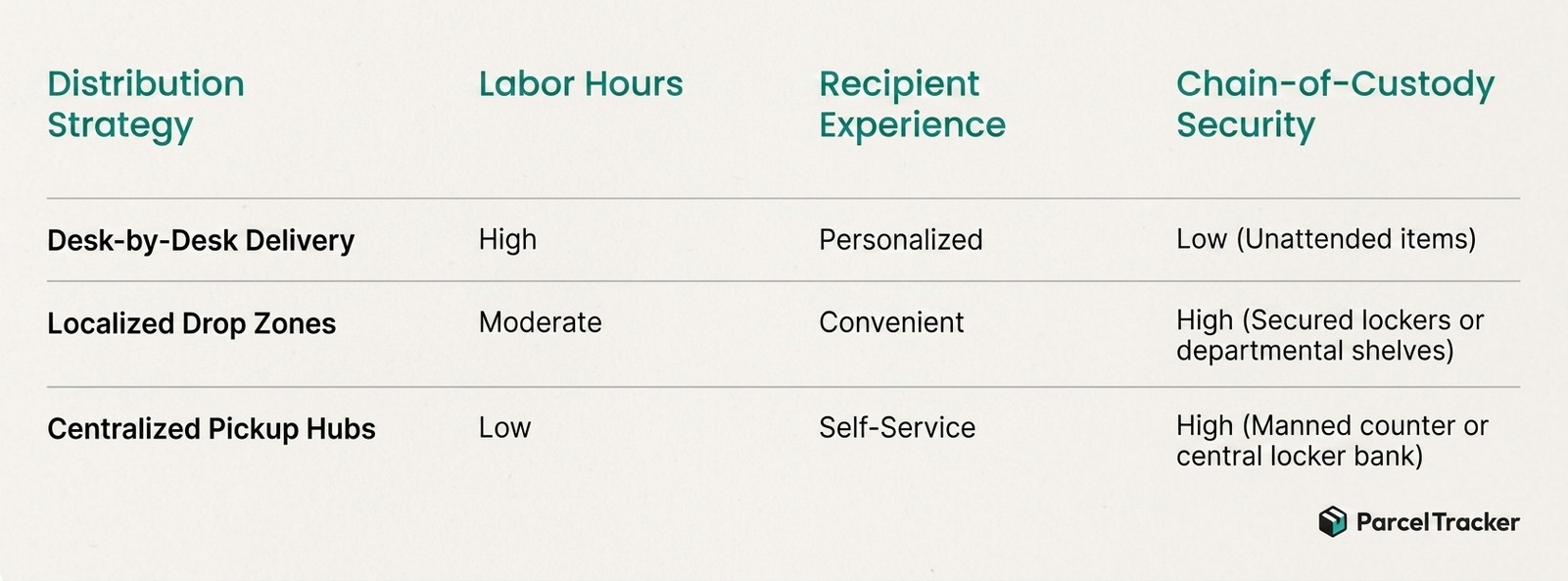
Each parcel distribution strategy aligns with specific building profiles and organizational needs:
- Desk-by-Desk Delivery: Best suited for single-story offices or small facilities with under 50 employees, where short walking distances keep total labor manageable and personalized service is prioritized.
- Localized Drop Zones: Ideal for multi-floor corporate offices, high-density sites, and large campuses. Establishing designated drop areas on each floor or wing strikes an optimal balance between reducing staff floor time and providing easy package access for recipients.
- Centralized Pickup Hubs: Best tailored for high-security facilities, government buildings, or dense urban towers. Consolidating all package collections at a single secure counter or smart locker bank maximizes chain-of-custody control while keeping mailroom labor at absolute minimums.
Transitioning to localized drop zones generally offers the best compromise between team efficiency and recipient satisfaction, supporting up to a 30% reduction in processing time.
Pre-Distribution Mechanics: Batch Scanning at the Mailroom
.png)
Establishing an organized sorting protocol before any physical delivery begins is critical to preventing lost parcels and wasted trips across the building. A structured receiving mechanics ensures that staff categorize items quickly at the main desk. It lays a solid foundation for seamless internal routing.
- Zero-Motion Intake Routine: Keep every package at the primary mailroom until staff complete full intake logging. Scanning items upon arrival builds an accurate record before physical movement begins across the facility.
- Optical Batch Sorting: Utilize optical character recognition or mobile barcode scanners to process dozens of items per minute. Software categorizes incoming packages into designated route buckets such as Tower A - Floor 4, Research & Development, or Executive Suite.
- Staged Automated Notifications: Program notifications to send recipient alerts only after packages are sorted into their specific route buckets. Holding notifications until the delivery run begins stops employees from coming down to the mailroom while staff are actively sorting. Proper intake scheduling elevates overall productivity, aligned with broader logistics data showing smart routing can cut delivery time by 30 to 40%.
Step-by-Step Route Schedule Framework
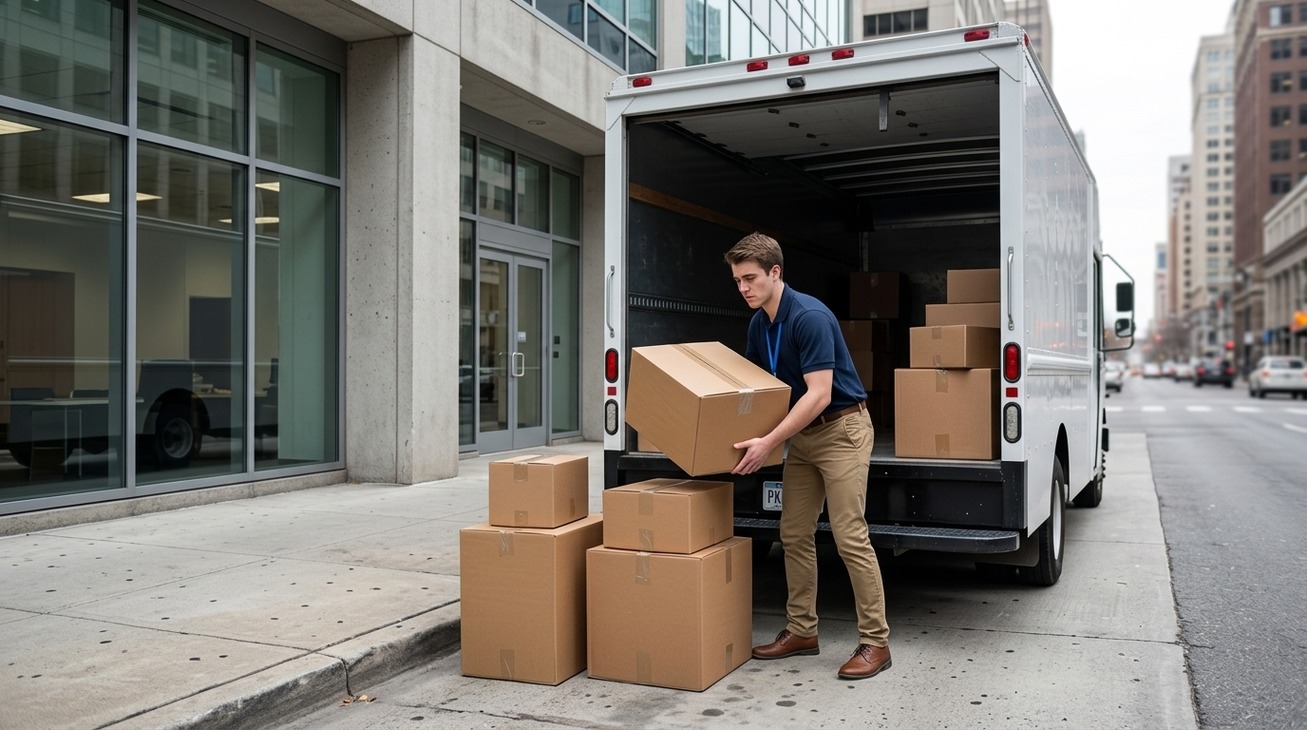
Establishing a predictable internal delivery schedule requires evaluating physical building constraints and setting clear expectations with department leads.
Conduct a Time-and-Motion Audit
Map the physical building footprint by measuring elevator wait times, floor traversal speeds, and security access checkpoint times. Use this timing data to establish accurate baseline durations for full building loops.
Establish Fixed Drop Windows
Replace continuous, ad-hoc deliveries with two or three scheduled runs throughout the day. A morning run at 10:00 AM and an afternoon run at 2:00 PM create reliable delivery expectations for building tenants while preserving uninterrupted blocks of time for mailroom tasks.
Apply Dynamic Sequence Mapping
Organize physical stops based on building geography. A top-floor-downward progression allows couriers to move systematically through the floorplan, avoiding repetitive elevator trips and unnecessary retracing of steps. Comprehensive parcel management frameworks rely on these spatial paths to maintain steady progress across large multi-building sites.
Scaling Campus Operations with Integrated Technology

Advanced facility infrastructure requires mailroom software to maintain oversight across multi-tiered delivery routes. Enterprise environments rely on specialized parcel management systems to support growing delivery volumes without increasing headcount.
- Multi-Hop Tracking: Maintain complete visibility as packages transfer from the central mailroom to floor-level staging rooms and final localized drop zones.
- Internal Courier Management: Assign specific floor routes to individual team members while capturing digital signatures and photo proof of delivery on mobile handhelds.
- Automated Audit Logs: Eliminate manual paper manifests to ensure clean digital records for every item. Digital verification helps teams achieve a 95% on-time delivery rate across complex corporate sites.
Upgrading Campus Mailroom Management
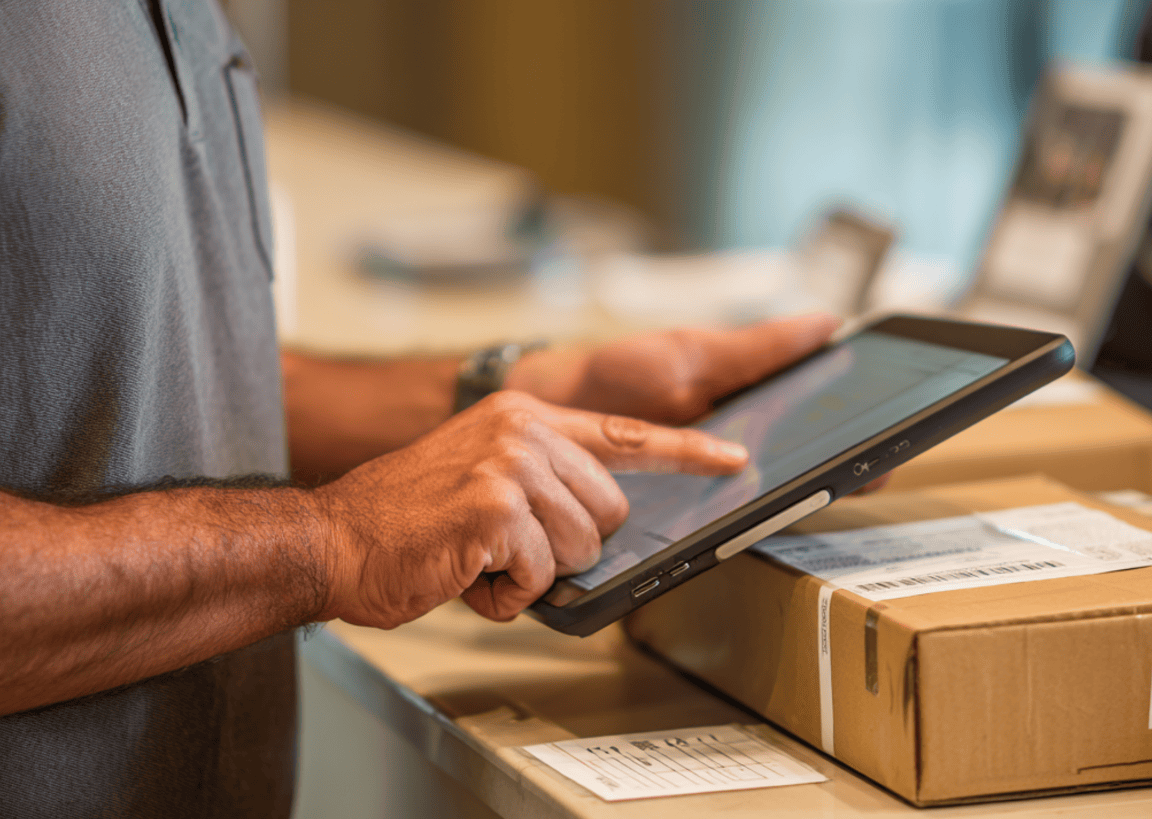
Optimizing internal delivery routes requires matching sensible spatial planning with reliable tracking tools. Enterprise facilities rely on dedicated internal software to maintain total visibility over every package in transit.
Using specialized mailroom management software like Parcel Tracker enables facilities teams to execute multi-hop tracking, eliminate fragmented delivery runs, and maintain verified custody logs across every floor and building.
Expert FAQ
What is an internal delivery route in mailroom management?
An internal delivery route is a structured, scheduled path facility staff follow to distribute packages within a building.
How does batch scanning improve internal delivery efficiency?
Batch scanning logs multiple packages instantly at intake, automatically grouping items by floor or zone to eliminate backtracking.
Why are localized drop zones better than desk-by-desk delivery?
Localized drop zones consolidate delivery stops, significantly cutting staff walking time while keeping packages secure in designated areas.
What is multi-hop tracking in enterprise internal logistics?
Multi-hop tracking maintains complete chain-of-custody visibility as packages move through intermediate staging locations to final drop points.
How many daily internal delivery runs should a facility schedule?
Scheduling two to three fixed daily delivery runs balances facility labor limits with prompt employee package availability.


.svg)