.svg)
Solving the International Name Matching Problem in PBSA Parcel Management

Step into a modern Purpose-Built Student Accommodation (PBSA) lobby at 3:00 PM on a Tuesday. The space is a sea of cardboard, and front-desk staff are sorting through hundreds of packages. Modern student developments are navigating a massive shift; data from the National Multifamily Housing Council (NMHC) reveals that communities must manage an average of 150 incoming packages every week, a number that surges by 81% during peak periods.
This volume is driven by a highly diverse, global student demographic. According to the Higher Education Statistics Agency (HESA), the number of full-time international students has skyrocketed by 81% over the last decade. PBSAs are dealing with massive package volumes while serving residents from all over the world. When international naming variations meet rigid, outdated databases, traditional sorting processes stall. Embracing automated mailroom management is key to keeping these high-volume facilities organized and efficient.
Anatomy of a Mismatch: Common International Naming Hurdles

Below are the label-to-directory friction points front-desk teams encounter every single day:
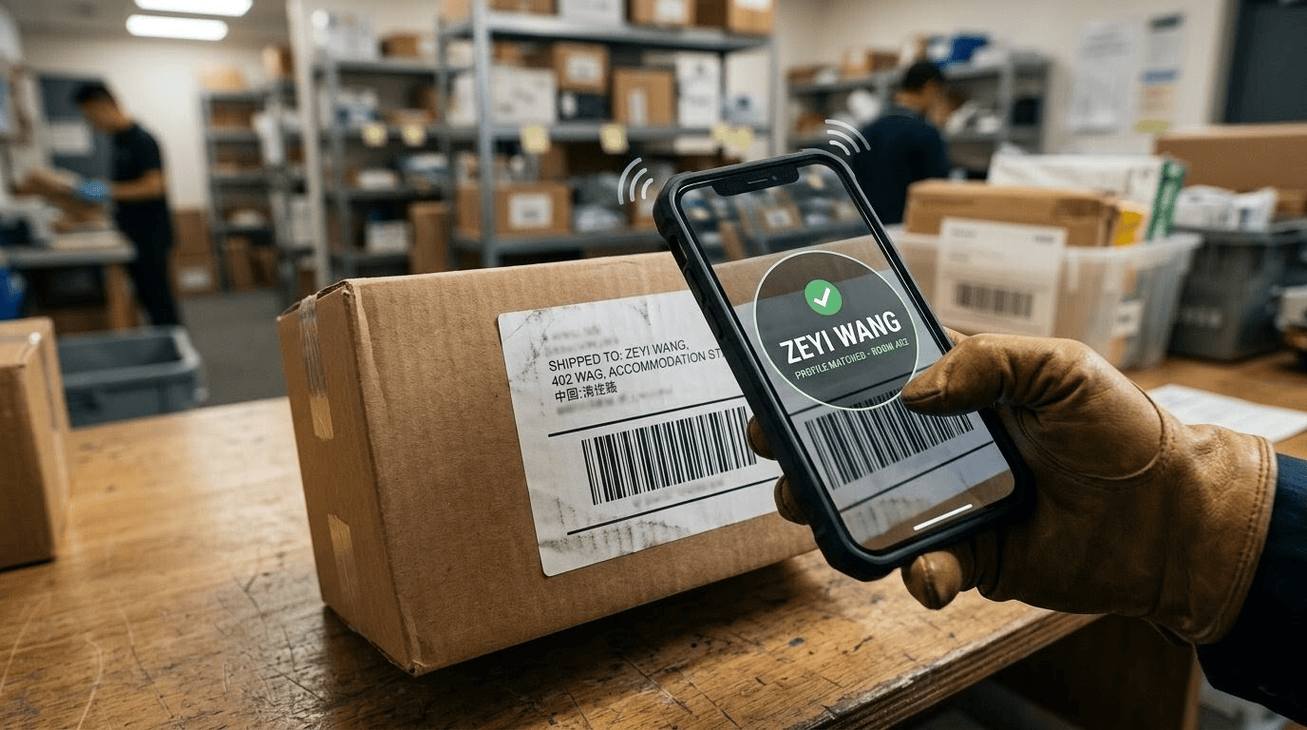
- The Anglicized Alias vs. Passport Registration: A package arrives addressed to "Jerry Wang." However, the official property registration database only contains the student's legal passport name: "Zeyi Wang." A standard alphabetical database search for "Jerry" yields zero matches.
- Reversible Naming Order Structures: A courier label is printed using East Asian naming standards (Family Name first, Given Name second), reading "Kim Min-jun." The student directory is logged in Western order: "Min-jun Kim." Rigid search software indexes "Kim" as the first name, failing to automatically associate the package with the correct student profile.
- The Truncated and Shorthand Courier Label: A shipping label gets cut off due to character limits, displaying "A. Rodri, Rm 302." The resident directory lists "Alejandro Rodriguez-Gomez" in Room 302. Standard scanning tools fail to find an exact character-by-character match, flagging the parcel as an unknown recipient.
Consequences of Mismatches in Student Housing

When simple labeling errors occur, they trigger a series of challenges that ripple across the mailroom and the entire building:
- Wasted Time Looking for Parcels: Front-desk staff must pause their primary duties of assisting residents to manually cross-reference resident directories, email threads, or physical lease agreements just to identify the true owner of a mismatched package.
- Physical Clutter in the Lobby and Mailroom: Unmatched parcels cannot be assigned to secure lockers or designated shelves. They remain in reception areas, accumulating in temporary piles that compromise the aesthetic of the building lobby.
- Delayed Resident Notifications: Delays in matching names mean students see their carrier's delivery confirmation on their phones hours before the property registration system officially logs the package. This leads to anxious inquiries and preventable congestion at the front desk.
AI-Driven OCR to the Rescue

Modern accommodations are succeeding by deploying advanced artificial intelligence to resolve these issues instantly. Unlike legacy optical character recognition (OCR) that simply reads flat text, AI-driven OCR reads for context. It identifies patterns, separating names from addresses and tracking numbers with high accuracy.
Through the use of fuzzy matching algorithms, the software calculates probability. It instantly recognizes that "A. Rodri" in Room 302 has a 99.9% probability score of being "Alejandro Rodriguez-Gomez."
The system also performs dynamic directory cross-referencing. The AI parses multiple data points simultaneously, including room numbers, partial phone numbers, and historic carrier data to verify student identity in milliseconds. Utilizing smart parcel management systems ensures that every package is accounted for, regardless of how the sender formatted the label.
Shifting from Hours to Seconds
Implementing intelligent, AI-powered naming resolution brings immediate advantages to high-density student communities:
Automated Notifications
The moment the AI resolves a name mismatch, an automated SMS or email is dispatched. This ensures residents know exactly when to collect their deliveries.
Time Optimization
On-site teams spend mere seconds scanning a package instead of several minutes hunting down a resident's real identity, keeping desk lines short and staff focused on student well-being.
Clear Common Areas
Organized intake prevents packages from stacking up in common spaces, preserving a clean, welcoming, and high-end environment for visitors and prospective residents.
Beyond OCR: Futuristic Solutions on the Horizon
As mailroom technology continues to progress, student housing logistics will become even more streamlined through next-generation innovations:
- Tokenized and Biometric Last-Mile Handovers: Future parcel systems may eliminate names on labels entirely. Couriers could scan a temporary, secure QR token printed on the shipping label that pairs the package with a resident's secure digital ID, maintaining complete privacy.
- Predictive Space Allocation AI: Machine learning models will analyze historical ordering patterns to pre-allocate smart locker space before the delivery vehicle even arrives at the property.
- AR-Assisted Sorting Visors: Wearable smart glasses will project digital overlays onto packages as they are unloaded, highlighting recipient details and mapping out the exact shelving path in the staff's field of view.
Enhancing the Student Living Experience

A student's accommodation is their home. Receiving packages from family or securing vital online orders is a crucial part of their daily life. Operators can maintain a high standard of service by ensuring linguistic and formatting variations do not slow down delivery times.
Ready to simplify your reception desk workflow? Experience how Parcel Tracker leverages advanced OCR to accurately match names, instantly notify residents, and maintain an organized, stress-free environment.
Expert FAQ: International Parcel Management in Student Housing
How does AI-driven OCR match anglicized names to official student directories?
AI OCR utilizes fuzzy matching algorithms to cross-reference partial matches, room numbers, and contact details with the official property database.
What causes the most package logging delays in PBSA mailrooms?
Linguistic differences, reversed naming orders, shortened labels, and discrepancies between legal registration names and preferred online shopping aliases.
Why can't traditional barcode scanners solve international name mismatches?
Traditional scanners only read static data fields, whereas AI systems actively interpret context, typos, and cultural naming structures dynamically.
What is fuzzy matching in student housing mailroom software?
A search protocol that identifies non-exact matches by calculating probability scores between misspelled or abbreviated label names and resident directories.
How does automated name matching improve student retention rates?
It ensures rapid parcel notifications, eliminates lost packages, and delivers the seamless, tech-forward living experience modern students expect.


.svg)