
.svg)
State of AI in the Mailrooms

AI in mailroom management is the application of machine learning and computer vision to automate the intake, sorting, and distribution of physical assets. It replaces manual data entry with high-speed digital scanning, ensuring a secure chain of custody, instant recipient notification, and 100% accuracy in parcel management for modern enterprises and educational institutions.
Corporate, residential, and university mailrooms have become a critical node in the global supply chain. As global parcel volume is projected to reach 407 billion packages annually by the end of 2026, traditional manual logging is no longer a viable strategy. Modern mailroom management software has evolved into an agentic system, capable of making autonomous decisions that were previously left to human staff.
For mailroom managers, this means survival in an environment that processes over 710 parcels every second in the U.S. alone.

The Evolution of Parcel Management: Manual vs. AI-Driven
Legacy systems are increasingly viewed as a liability due to their lack of transparency and high labor costs. Research indicates that logistics operations applying AI are seeing 5–20% cuts in operational costs while improving service levels by up to 65%.
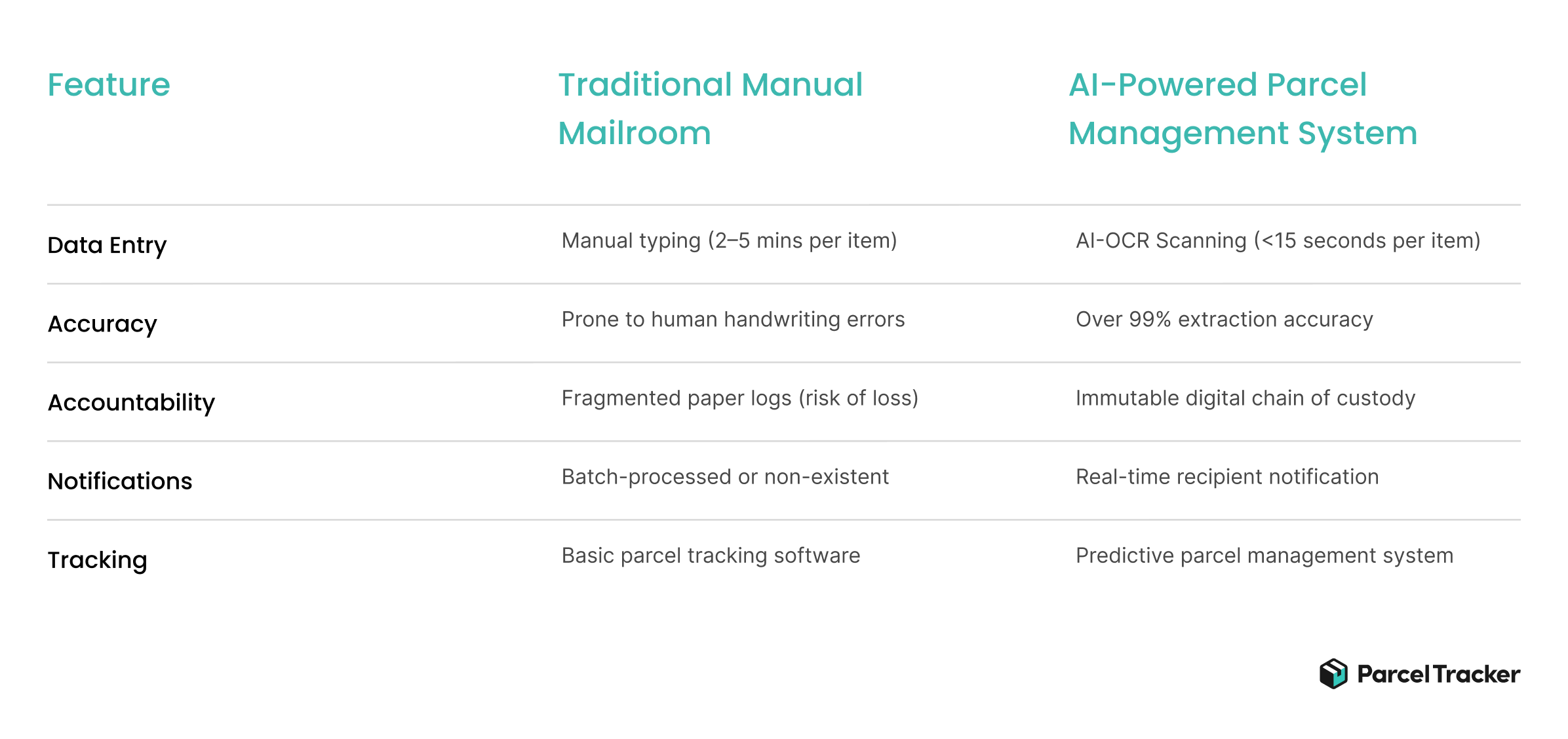
The data above illustrates a shift in Time-to-Value. Transitioning from manual entry to a digital parcel management system enables organizations to effectively reduce logging time by over 75%. This transformation is powered by modern OCR, which has moved beyond simple character recognition to Intelligent Document Processing (IDP), capable of understanding context even on damaged or handwritten shipping labels.
Tailoring AI for Different Mailroom Environments
While the core technology remains the same, the application of AI varies significantly across different high-volume sectors. Whether in a high-rise office or a sprawling campus, AI-driven package management is solving unique pain points.

1. Corporate Workplaces
In the corporate world, the mailroom is the gatekeeper of sensitive information. Mailroom automation now integrates directly with enterprise directories, ensuring that legal documents and high-value hardware reach the correct desk in record time. AI helps reduce the 60–70% of labor traditionally spent on manual mail sorting, allowing office managers to focus on high-impact workplace experience tasks rather than chasing delivery slips.
2. Residential Buildings & Multi-Family Housing
For residential property managers, the parcel problem is a top-three resident complaint. AI-powered systems address this by predicting peak delivery times and automating recipient notification. By using Zero Trust digital access, these systems ensure that only verified residents or couriers can access storage areas, significantly reducing the risk of theft in high-density urban builds.
3. Universities & Student Housing (PBSA)
Higher education faces a unique space-to-volume crisis. Campus mailrooms are often overwhelmed. AI helps by automating the purge of stale data by identifying packages for residents who have graduated or moved out, which frees shelf space previously occupied by undeliverable mail.
How AI Automates the Inbound Logistics Workflow
To achieve the ROI expected in 2026, the best package tracking app solutions follow a specific, logic-driven framework. This process ensures that high-volume sorting and final-mile delivery are handled with minimal human intervention.
..png)
- Autonomous Capture: AI-powered computer vision geocodes the arrival of a package, extracting the carrier, tracking number, and recipient name from labels in seconds.
- Fuzzy Logic Directory Matching: The parcel management system cross-references extracted data against the building directory or student database, automatically resolving nicknames or misspellings.
- Instant Recipient Notification: Upon a successful match, the system triggers a real-time alert via Slack, SMS, or Email, reducing package dwell time in the mailroom.
- Priority Categorization: AI-driven insights identify high-priority assets, such as temperature-sensitive items, legal documents, or student medications, flagging them for immediate delivery.
- Verified Handoff: The recipient provides a digital signature or scans a QR code, which the system records as absolute proof of delivery.
Why 2026 is the Year of Mailroom Automation

Current industry data suggests we have moved past the experimental phase of AI. According to the latest Pitney Bowes Parcel Shipping Index, carrier disruption and the rise of Amazon Logistics are forcing the adoption of more flexible and tech-forward solutions.
Businesses and universities that implement mailroom automation today are gaining an edge in three specific areas:
- Operational Scalability: AI allows teams to handle a 5% CAGR in parcel volume through 2030 without increasing headcount.
- Asset Security: Every movement is logged, creating a searchable audit trail essential for HIPAA, GDPR, or SOC2 compliance.
- Resident Satisfaction: In both high-end residential and PBSA settings, seamless parcel management reduces churn by eliminating the frustration of lost or delayed packages.
As we look toward the future, the transition from reactive receiving to proactive inbound logistics will define the most efficient workplaces and campuses. Systems that offer advanced parcel tracking software are the backbone of a modern, frictionless experience.

If you’re ready to modernize your building's operations and eliminate the occurrence of lost parcels, consider how a professional mailroom management software can turn your logistics headaches into a streamlined digital experience.
Expert FAQ
How does mailroom management software reduce operational costs?
By automating data extraction and indexing, businesses can reduce manual processing time by up to 85%. This allows staff to be redeployed to higher-value tasks, such as student support or facility management.
What is the role of AI in maintaining a secure chain of custody?
AI creates a permanent, digital paper trail that includes timestamps, photos of the parcel’s condition, and verified proof of delivery, ensuring high-value assets are tracked from the loading dock to the recipient's hand.
Why is a parcel tracking software essential for student housing (PBSA)?
Students today expect instant communication. AI systems provide real-time recipient notification, preventing overcrowding in small mailrooms and ensuring students don't have to wait in long lines during move-in peaks.
What makes a system the best package tracking app for 2026?
The best systems use agentic AI that autonomously resolves address discrepancies and integrates with enterprise tools such as Microsoft Teams, Slack, or university portals to ensure seamless final-mile delivery.


.svg)

