
.svg)
How Healthcare Facilities Track Incoming Lab Samples Internally?

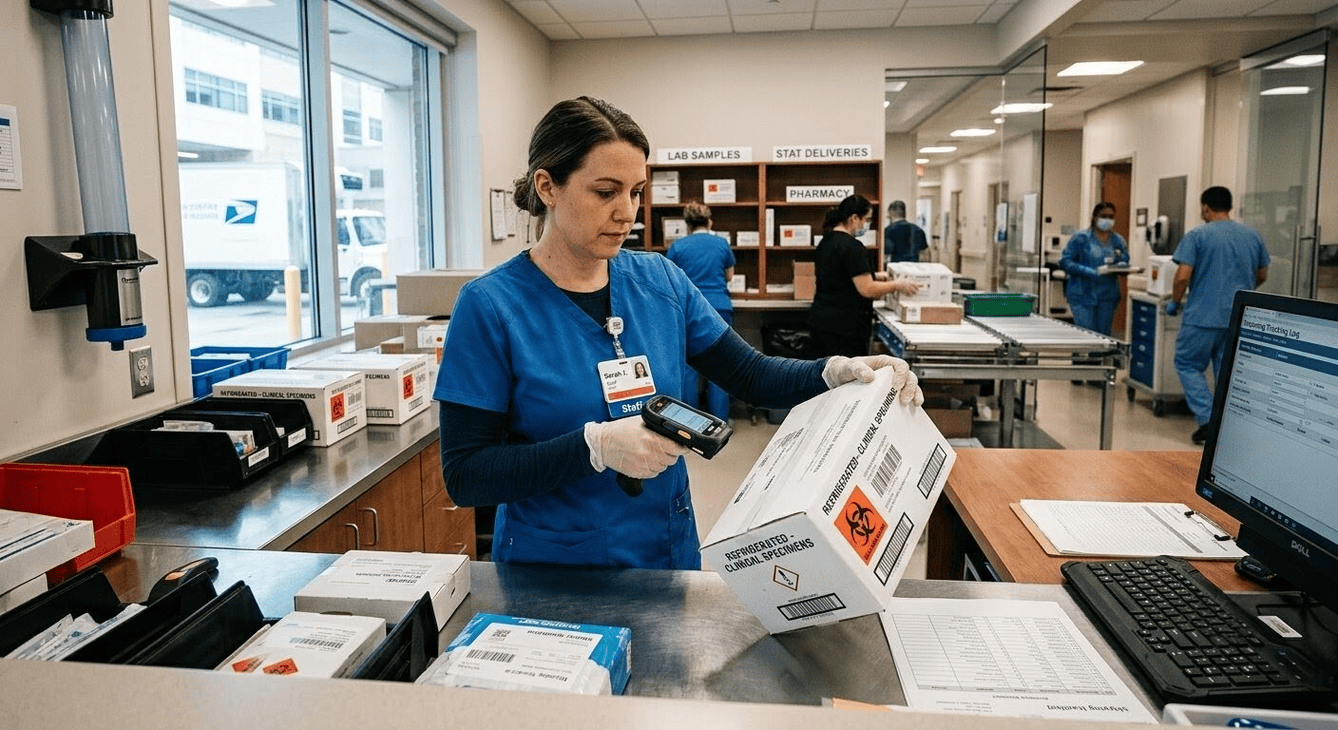
The internal journey of a medical package within a healthcare facility holds the same clinical weight as the laboratory testing itself. When a diagnostic specimen arrives at a hospital loading dock or central mailroom, it enters a high-stakes internal logistics chain. Misplacing or delaying a specimen disrupts operations and compromises patient care. Healthcare networks use specialized technology and structured workflows to maintain end-to-end visibility over these critical assets. Discover how the Parcel Tracker Healthcare Solution provides end-to-end visibility and compliant data security to accelerate medical deliveries from the moment they arrive.
Internal specimen tracking is the structured chain-of-custody process of monitoring a medical package from the facility's loading dock or central mailroom directly to the clinical testing laboratory.
What Are the Key Challenges in Internal Specimen Logistics?

Managing medical deliveries involves navigating complex regulatory frameworks and time-critical windows. Healthcare facilities face several operational hurdles when moving items from the front door to clinical teams:
- Maintaining Chain of Custody: Administrative staff must record every individual handoff to prevent lost or misplaced diagnostic samples.
- Managing Time-Sensitive Deliveries: Personnel must prioritize STAT samples, urgent medications, and strict temperature-controlled biological items over standard freight.
- Handling High Volume and Variety: Hospital logistics teams manage highly diverse packages, ranging from standard diagnostic kits to urgent biopsy containers across multi-site healthcare networks.
- Overcoming a Lack of End-to-End Visibility: Facilities often experience tracking blind spots when items transition away from the central dock to internal couriers.
- Eliminating Labor-Intensive Manual Processes: Relying on paper logs slows down incoming intake and increases data entry errors during peak hours.
- Meeting Strict Regulatory Compliance: Logistics teams must protect sensitive patient data during delivery handling to satisfy stringent regulatory standards. Maintaining strict mailroom compliance and chain of custody protocols is necessary to adhere to privacy frameworks like HIPAA, GDPR, and ISO27001.
- Securing Chain-of-Custody Proof: Facilities face liability risks when delivery confirmations lack verification methods like digital signatures or photo proof.
What Is the Standard Workflow for Tracking Incoming Lab Samples?
Overcoming internal delivery challenges requires a clear, linear workflow. Modern healthcare facilities standardize their intake and distribution into four distinct steps.
Step 1: Centralized Intake at the Mailroom or Loading Dock

The internal tracking process begins immediately when an external courier drops off a shipment. Mailroom teams handle high volumes efficiently by using flexible logging protocols. Staff use bulk receiving features to log entire carrier manifests at once, or blind receiving protocols to process unexpected, unregistered medical shipments safely. This initial step separates standard business mail from urgent medical specimens and clinical supply items.
Step 2: Digital Logging and AI-Powered Scanning
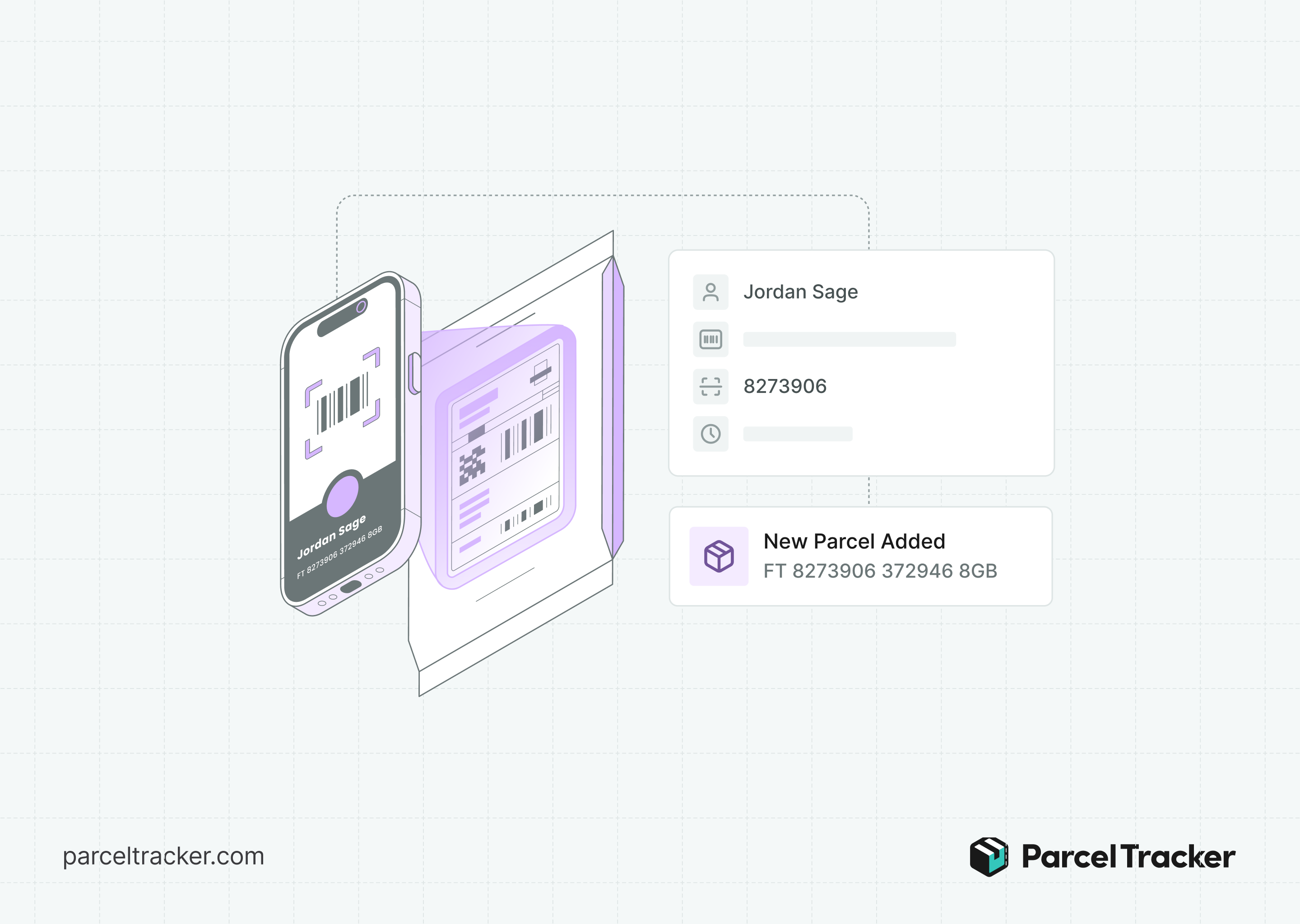
Manual data entry slows down intake lines and introduces processing risks. Modern reception desks rely on advanced digital logging systems equipped with AI-powered scanning. Implementing optical character recognition (OCR) in mailroom management allows personnel to scan carrier barcodes, shipping labels, and handwritten text instantly. The system automatically captures time-stamps, identifies courier details, and extracts relevant purchase order numbers without manual typing.
Step 3: Internal Multi-Step Routing
Medical packages rarely travel in a straight line from the loading dock to the analyzer. Shipments often move across multiple departments, temporary storage areas, or clinical sites. Tracking software records every internal milestone. This digital record creates a full audit trail for each asset, preventing delivery bottlenecks in facility corridors. Automated updates also reduce communication gaps; utilizing an automated parcel notification workflow ensures that clinical staff receive instant alerts the moment a critical specimen moves closer to their department.
Step 4: Laboratory Receipt and Secure Proof of Delivery
The internal logistics chain concludes when the specimen reaches its destination clinical team. Technicians complete the delivery loop by scanning the package at the laboratory receiving desk. To eliminate disputes, the recipient provides secure proof of delivery through digital signatures, photo verification, or unique QR code scans. Lab staff then cross-reference the package details with Laboratory Information Systems (LIS) to begin diagnostic testing.
Which Essential Technologies Drive Modern Medical Logistics?

Hospitals rely on a combination of hardware and software to eliminate tracking gaps across complex facilities:
- Barcode and RFID Systems: Scanning hardware removes manual logging errors during internal transit checkpoints.
- Real-Time Location Systems (RTLS): Wireless tracking tags monitor high-value, temperature-sensitive shipments continuously across hospital floors.
- Integrated Mailroom Platforms: Dedicated software bridges the communication gap between the building's front door and clinical departments while maintaining data security compliance.
What Are the Best Practices for Minimizing Specimen Loss?
Technology functions best when supported by strong operational habits. Healthcare leaders implement targeted organizational practices to ensure consistency:
- Standardizing Operating Procedures (SOPs): Hospitals establish clear logging rules that apply to all administrative, mailroom, and medical staff.
- Providing Continuous Staff Training: Onboarding programs train mailroom personnel and lab technicians using intuitive digital applications to ensure compliance.
- Executing Regular Logistics Audits: Operations managers review internal transit times regularly to identify bottlenecks and optimize delivery paths.
How to Achieve Diagnostic Efficiency Through Automated Logistics?

Efficient internal tracking safeguards patient health, eliminates human error, and optimizes hospital workflows. Implementing dedicated logistics technology helps medical facilities maintain a flawless cradle-to-grave tracking system from the moment a package arrives.
Optimizing daily workflows allows administrative teams to spend less time sorting freight and more time supporting clinical objectives. Transitioning away from legacy paper processes protects data integrity and accelerates delivery speed across all departments. To optimize general business operations, explore how a modern mailroom management system can upgrade your facility's daily mailroom management and overall parcel management strategy. Utilizing advanced package tracking software and delivery tracking software keeps your critical healthcare logistics moving safely and accurately. Discover how Parcel Tracker can optimize your medical facility's internal mailroom logistics and specimen receipt workflows.
Expert FAQ: Internal Medical Logistics
What is internal specimen tracking?
Internal specimen tracking is the digital monitoring of diagnostic samples from facility arrival to laboratory delivery.
How do hospitals maintain sample chain of custody?
Hospitals maintain chain of custody by scanning unique barcodes at every transfer point between couriers and technicians.
Why do medical facilities automate mailroom logging?
Facilities automate mailroom logging to eliminate human error, accelerate delivery times, and prevent lost diagnostic samples.
What technology tracks incoming healthcare packages?
Barcode scanners, RFID tags, and specialized mailroom management software track incoming healthcare packages effectively.
How does efficient internal logistics improve patient care?
Efficient internal logistics improves patient care by reducing turnaround times for critical laboratory diagnostic test results.


.svg)

