.svg)
Mailroom Vendor Management in Highly Regulated Industries

Physical mail and parcel delivery remains a core component of daily operations for major organizations. Incoming packages, certified letters, and courier envelopes carry sensitive medical records, corporate contracts, and live financial checks across facilities every single day. While digital infrastructure receives significant security investment, physical document and parcel intake requires equal discipline.
Partnering with third-party service mailroom solution providers introduces outside personnel into internal sorting centers and parcel distribution routes. Managing these service partners through systemic protocols preserves organizational security and maintains regulatory standards across every physical handoff.
The Real Compliance Vulnerabilities in Physical Mail and Parcel Operations

Corporate security policies often prioritize digital firewalls, network monitoring, and encrypted messaging channels. Meanwhile, physical mailrooms process high-value mail and parcels using manual paper logs or basic sign-in sheets. This disconnect creates vulnerability at the physical entry points of an organization.
A single misrouted parcel can contain protected patient files or a court summons with a rigid response window. When third-party staffing agencies or facility vendors handle incoming mail items and packages without strict oversight, the risk of lost records increases significantly. Vendor oversight establishes clear accountability standards, binding external partners to the exact same security requirements enforced across internal IT systems. Modern organizations view physical intake security for mail and parcels as a primary risk-mitigation strategy to safeguard sensitive assets.
Key Regulatory Frameworks Governing Physical Document and Parcel Handling

Specific industries operate under strict legal frameworks that extend to every physical piece of mail and parcel entering a facility. Maintaining compliance across these varied legal obligations requires implementing a range of targeted safeguards:
- Healthcare Compliance Standards (HIPAA): Facilities receiving patient records, lab samples, or billing notifications via mail and parcel delivery must maintain strict physical access controls. External workers handling incoming medical packages and envelopes need specific privacy training to prevent unauthorized exposure of patient information during sorting.
- Financial Services Safeguards (GLBA & SOX): Financial institutions regularly receive negotiable instruments, cashier's checks, and confidential audit documents through express parcel services. External vendors must follow verifiable chain-of-custody protocols to ensure full tracking from the loading dock to the finance department.
- Legal Notice Requirements: Court summonses, subpoenas, and regulatory notices delivered by mail carry statutory deadlines. Proper vendor management ensures immediate time-stamped logging upon arrival to preserve legal defense capabilities.
- Government and Public Sector Mandates: Government contractors and agencies receiving mail and parcels containing classified or controlled unclassified information (CUI) must enforce strict physical security perimeters and cleared-personnel sorting rules.
- International Privacy Regulations (GDPR & CCPA): Incoming physical parcels and letters containing personal consumer data require immediate secure handling and restricted visibility to prevent cross-border data privacy violations during scanning.
- Mandatory Vendor Staff Screening: Third-party vendor contracts must enforce seven-year background checks, multi-panel drug screenings, credit checks for financial roles, and binding non-disclosure agreements for all personnel assigned to client mail and parcel sorting areas.
Implementing these requirements relies heavily on a tried and tested mailroom management strategy that aligns physical workflows with legal standards.
Securing Legal Chain of Custody for Summons and Compliance Mail

When a courier drops off a legal notice or sensitive package, the clock starts immediately for the receiving organization. A delayed handoff of critical mail to the legal department can lead to statutory penalties or default court judgments. Establishing a verified chain of custody ensures every legal document and parcel reaches the correct recipient on time.
Building a defensible intake process for incoming mail and parcels involves an end-to-end series of verifiable steps:
- Carrier Receipt Logging: Personnel inspect incoming packages and mail sacks for physical damage and record the delivery carrier name.
- Immediate Digital Intake: Staff scans incoming carrier tracking numbers immediately upon drop-off, logging the precise date, time, and receiving agent into a central database.
- High-Priority Flagging: Specialized software identifies legal keywords or sender addresses to automatically categorize parcels and letters as time-sensitive.
- Secure Holding: High-priority mail and packages move into locked, access-controlled mailroom bins rather than standard sorting shelves.
- Verified Recipient Handoff: Final delivery of any package or letter requires a digital signature, photo proof, and time stamp from the recipient, creating a permanent record of transfer.
- Automated Escalation Triggers: Internal systems track pending legal deliveries, sending automatic reminders to managers if a high-priority parcel remains uncollected past a designated timeframe.
- Archival & Audit Logging: Completed mail and parcel delivery records auto-archive into a secure database accessible during compliance audits.
Deploying parcel management technology helps facilities teams track high-stakes deliveries with complete precision.
Protocols for PHI Safeguards and Financial Check Handling
Processing protected health information (PHI) and negotiable financial instruments found in incoming mail and parcels requires specialized handling protocols within the mail center. Physical sorting areas for packages and letters should feature restricted-access zones accessible only by authorized personnel holding verified credentials.
For digital mailroom management, scanning workstations must run software that features line-of-sight privacy controls and automatic redaction capabilities. This prevents unauthorized workers from viewing sensitive patient data or account numbers during document digitization.
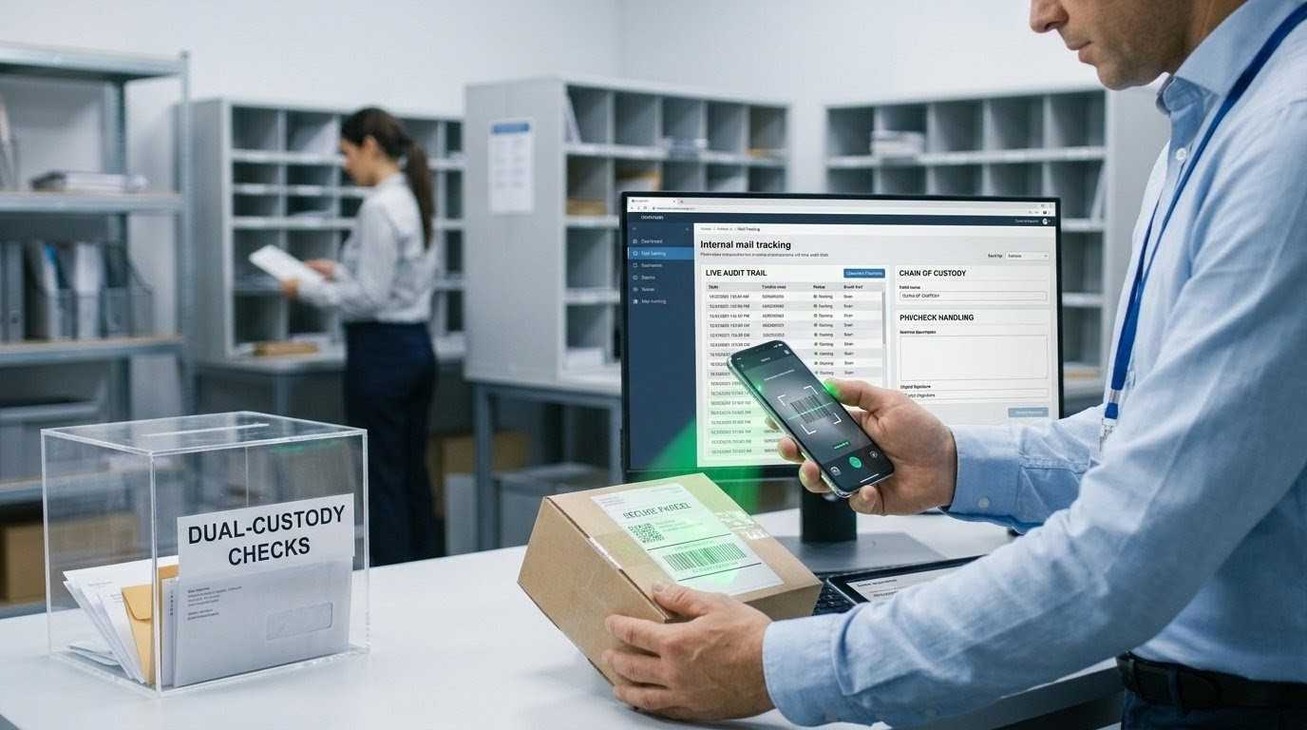
Financial checks arriving via mail and express parcel services require similar rigor. Mailroom staff must log incoming checks using dual-custody procedures, where two team members verify the contents before routing items to accounts receivable. Daily mail intake records are reconciled against accounting deposit logs at the end of every shift to maintain complete accuracy.
Establishing Complete Digital Audit Trails from Physical Intake to Storage

Maintaining full visibility across physical mail and parcel workflows requires connecting facility access data with digital document and package tracking.
Physical Entry Control
Facilities teams manage mail and parcel sorting room security by integrating keycard or biometric access points with internal logging systems. Every entry and exit is recorded, providing a clear history of who was inside the sorting facility at any given time.
Scanned Document and Package Access
When physical mail is scanned for digital delivery or parcels are logged into notification systems, access permissions must mirror standard corporate IT policies. Role-based access controls ensure only the intended recipient can view package details or download attached document scans. Immutable logs track every interaction, recording when a parcel notification or file was opened, printed, or forwarded.
Automated Retention Schedules
Digital records and scans of incoming mail and parcels are stored in accordance with corporate data retention frameworks. Automated policies purge stored tracking data and scans once the required retention period expires, ensuring compliance with privacy standards.
Procurement Checklist for Evaluating Regulated Mailroom Vendors
Selecting a qualified third-party partner to manage physical mail and parcel processing requires thorough evaluation during the procurement process. Evaluating prospective service providers requires reviewing several core areas:
- Security Certifications: Verify that the vendor maintains SOC 2 Type II or ISO 27001 compliance by reviewing recent third-party audit reports and SOC attestations.
- Personnel Vetting: Inspect hiring protocols to confirm mandatory seven-year criminal background checks, drug screenings, credit checks, and recurring privacy re-certifications for staff handling mail and parcels.
- Physical Facility Controls: Perform on-site facility inspections to verify 24/7 CCTV surveillance coverage, biometric entry points, clean-desk policies, and secure holding lockers for high-value packages.
- Technology Architecture: Request live system demonstrations to evaluate automated mail and parcel tracking, line-of-sight scanning, role-based permissions, and tamper-proof audit trails.
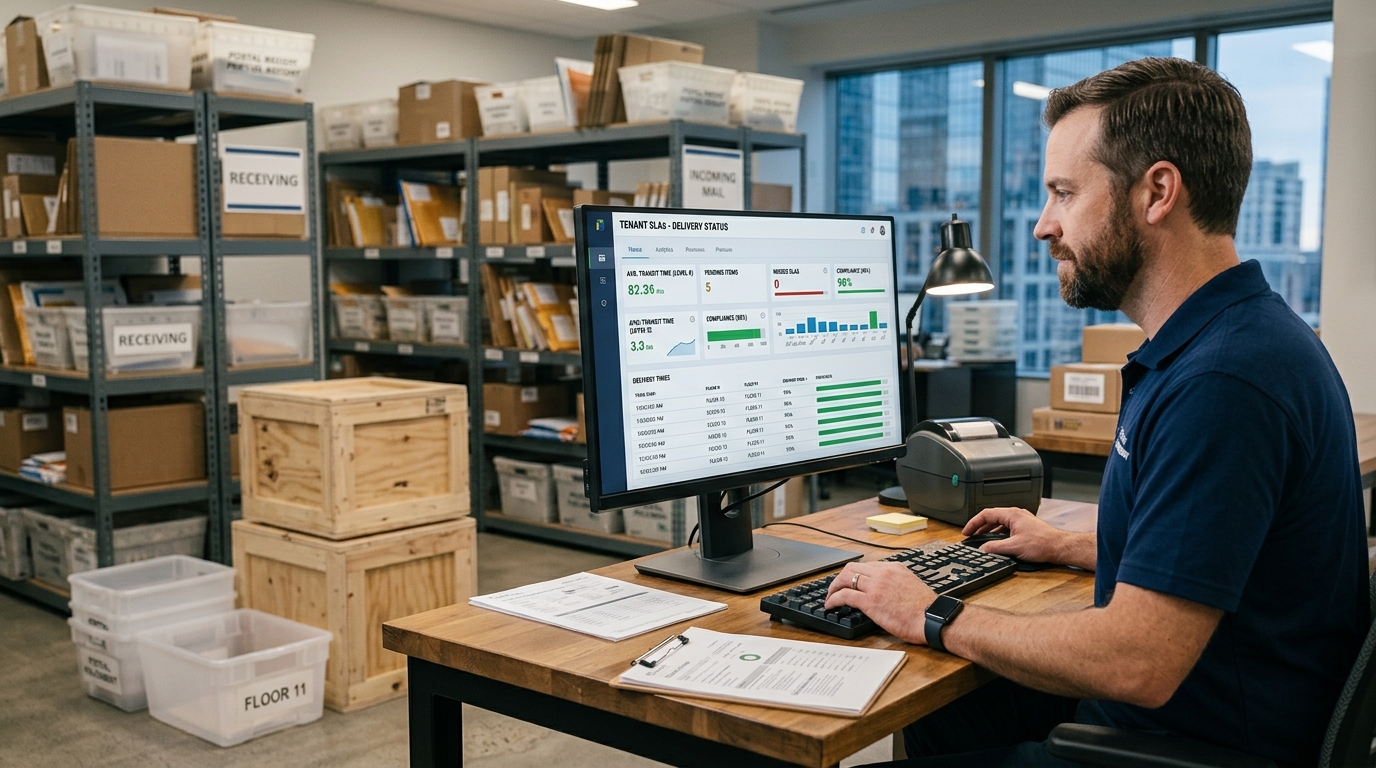
- Service Level Agreements (SLAs): Review contractual terms to ensure binding, time-stamped delivery deadlines for urgent legal parcels, financial instruments, and regulatory mail.
- Business Continuity & Disaster Recovery: Review documented backup plans for off-site mail and parcel sorting, emergency rerouting, and digital repository failovers during site disruptions.
- Insurance & Indemnification: Confirm adequate coverage levels for general liability, cyber liability, and errors and omissions regarding lost or breached physical mail and assets.
Creating Mailroom Workflows for Total Mailroom Compliance

Physical mail and parcel intake demands the exact same rigor applied to corporate software networks. Implementing clear vendor guidelines, strict staff screening, and time-stamped chain-of-custody protocols ensures complete control over incoming packages and letters. Moving away from manual paper tracking allows facilities teams to maintain full oversight while meeting demanding regulatory standards.
To secure physical document delivery and simplify chain-of-custody tracking across your facilities, consider streamlining your internal workflows with Parcel Tracker.
Expert Mailroom Compliance FAQ
How does mailroom vendor management protect regulated companies?
Mailroom vendor management establishes strict physical security, staff vetting, and digital tracking to prevent data breaches and legal non-compliance.
What is chain of custody in physical mail handling?
Chain of custody is the documented, time-stamped paper or digital trail recording a physical document's receipt, transfer, and final delivery.
Why do mailroom vendors require SOC 2 certification?
SOC 2 certification proves a mailroom vendor maintains strict controls to securely handle sensitive customer physical data and documents.
How are live checks securely handled in a regulated mailroom?
Live checks require dual-custody intake logging, restricted handling areas, and immediate daily reconciliation with internal financial accounting systems.
What compliance risks exist when scanning physical mail into digital formats?
Scanning mail risks unauthorized PHI exposure, unencrypted cloud storage, and non-compliance with data retention and automatic purge schedules.


.svg)