What is Parcel Lifecycle in Mailrooms


A parcel lifecycle is the complete journey a package makes inside a building, beginning when a carrier hands it over and ending when the recipient collects it or it returns to the sender. In a mailroom, that journey covers receiving, logging, sorting, notifying, storing, and releasing, with a record created at each step.
Carrier tracking ends at the delivery scan, and the mailroom's work starts at that same moment. A package marked delivered at 10:00 a.m. can sit on a shelf for days when no process tells staff what happens next. A defined lifecycle gives the team one sequence to follow and gives recipients a reliable answer about where their package is. It also forms the base of mailroom management, the broader practice of handling incoming and outgoing items consistently.
Volume makes that consistency worthwhile. The U.S. Postal Service alone handled an average of 22.7 million packages a day in 2025, and a share of those arrive at office towers and apartment communities where staff must account for each one.
6 Stages of a Parcel Lifecycle Inside a Mailroom
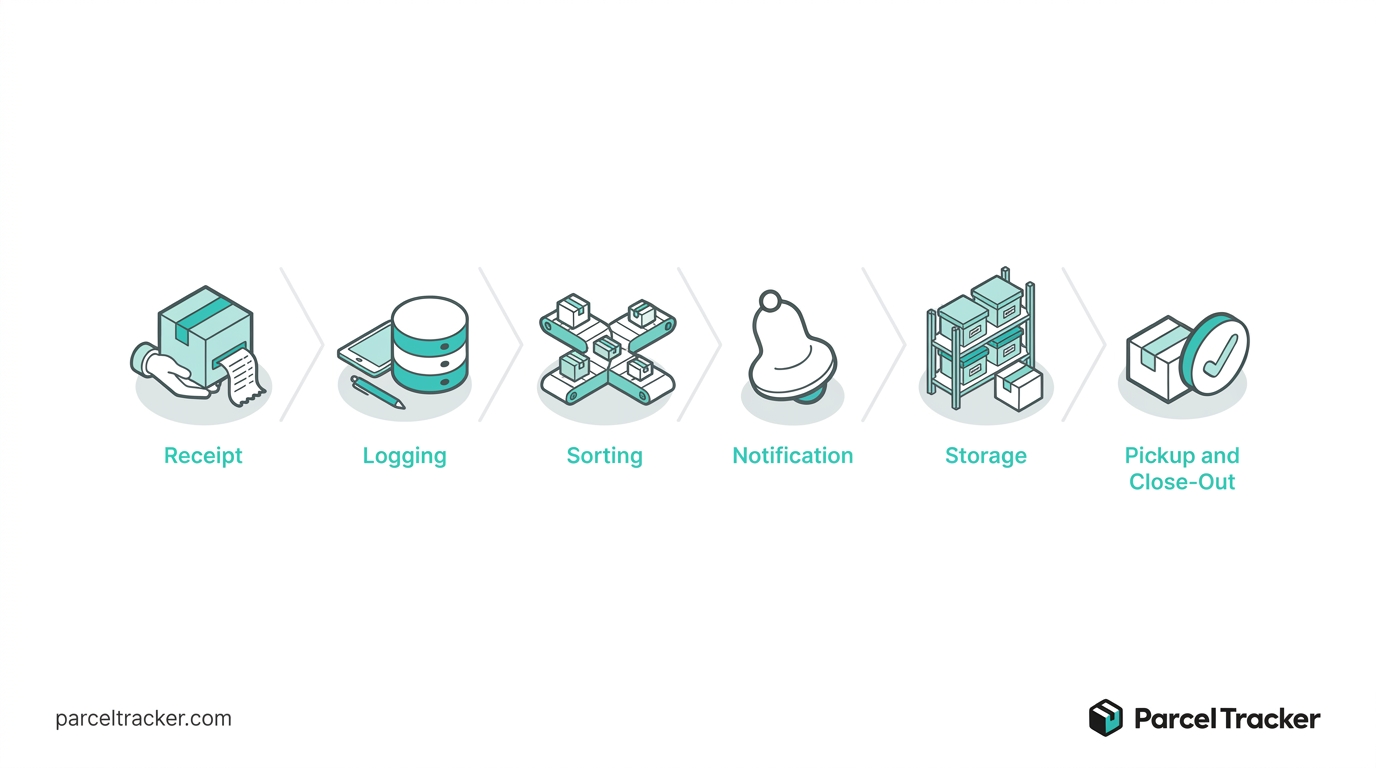
Most mailrooms follow the same six stages, even when tools and staffing differ. Each stage ends with a record that the next stage relies on.
- Receipt - Staff accepts the package from the carrier, checks the label and box condition, and notes any signature requirement.
- Logging - Staff captures the tracking number, carrier, recipient name, and unit or department, often through a label scan or a photo of the package.
- Sorting - Packages are grouped by destination and size, with separate handling for perishables, high-value items, and oversized boxes.
- Notification - The recipient receives an email or text that includes pickup hours and the package location.
- Storage - Each package gets a shelf or bin assignment and a holding period, so any team member can locate it in seconds.
- Pickup and close-out - Staff verify identity, collect a signature or code, and mark the package as released with a timestamp.
Packages left unclaimed past the holding period follow an exception path, such as return to sender or forwarding under building policy. Documenting that path is a core part of parcel management, since it gives staff a clear next step whenever a package overstays.
Where a Parcel Lifecycle Slows Down and How to Fix It
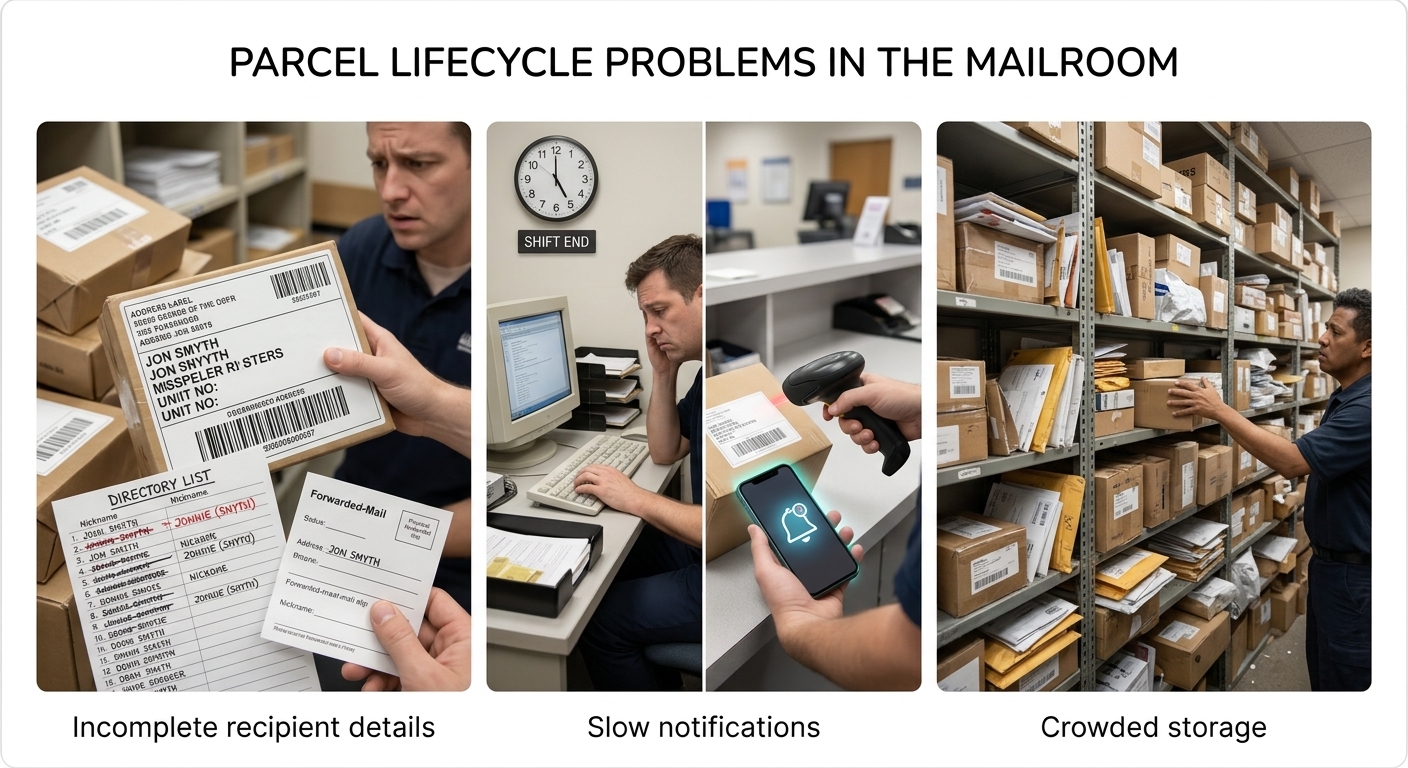
Online buying keeps adding to the load. The Census Bureau reports that e-commerce made up 17.1% of total retail sales in the second quarter of 2026, so more packages reach buildings with each passing quarter. Delays tend to cluster around a handful of weak points, and each has a simple remedy.
- Unlogged arrivals - Packages shelved before scanning leave recipients unaware that anything arrived. Scanning at the dock before storage closes that gap.
- Incomplete recipient details - Misspelled names or missing unit numbers cause misrouting. A current directory that includes nicknames and forwarding names reduces mismatches.
- Slow notifications - Manual emails sent at the end of a shift add hours to every pickup. Automated alerts triggered by the scan remove that wait.
- Crowded storage - Seasonal peaks fill shelves quickly and make retrieval slower. Location codes and pickup reminders keep inventory moving.
- Missing pickup records - Releases without a signature or code lead to disputes later. Digital sign-off provides a timestamped answer.
Metrics That Show Whether Your Parcel Lifecycle Is Working

Buildings with heavier volume often rely on mailroom management software that timestamps every stage and reports results without manual counting. Whether the data comes from software or a spreadsheet, four measures give a clear picture of lifecycle health.
Time to log covers the gap between carrier drop-off and a finished scan record. Recipients' wait for news is captured by time to notify. Dwell time counts the days a package sits before pickup, and the unclaimed rate shows how many packages pass the holding limit. A fifth number, the monthly exception count for damaged, misrouted, or unmatched items, rounds out the view.
Reviewing these figures each month highlights patterns that daily work can hide, such as longer dwell times on Mondays or notification delays after a staffing change. Those patterns guide decisions about shift coverage, shelf layout, and reminder timing.
Building a Reliable Parcel Lifecycle Starts With Clear Records

A parcel lifecycle works best when each of the six stages leaves a record the next stage can use. Scanning on arrival and sending prompt alerts are small habits that shorten waits and reduce lost packages, and monthly metrics show whether those habits are holding. Mailrooms that want every stage recorded in one place can explore Parcel Tracker for package logging and recipient notifications.
Expert FAQ: Parcel Lifecycle in Mailrooms
What is a parcel lifecycle?
A parcel lifecycle is the complete path of a package from carrier handoff through mailroom handling to recipient pickup.
How many stages does a parcel lifecycle have in a mailroom?
Most mailrooms follow six stages: receipt, logging, sorting, notification, storage, and pickup with signature or proof.
Why does parcel lifecycle tracking matter?
Tracking shows where each package sits, which reduces lost items and keeps recipients informed with accurate status updates.
How can a mailroom shorten the parcel lifecycle?
Scan packages at arrival and send instant notifications, then shelve items by location so staff can retrieve them quickly.
What causes parcels to stall in a mailroom?
Missed scans, unclear recipient details, delayed notifications, and crowded storage are the most common causes of stalled packages.